Tired of choosing between a road trip adventure in a caravan or a serene escape on the water in a houseboat? You’re forced to pick one vehicle, one lifestyle, leaving half your dreams behind every time you pack up. The frustration builds: separate storage costs, extra towing hassles, missed remote spots where land meets water.
What if one vehicle could deliver both worlds seamlessly, towing easily like a caravan on highways, then launching into rivers, lakes, or calm coastal waters to become your floating home?
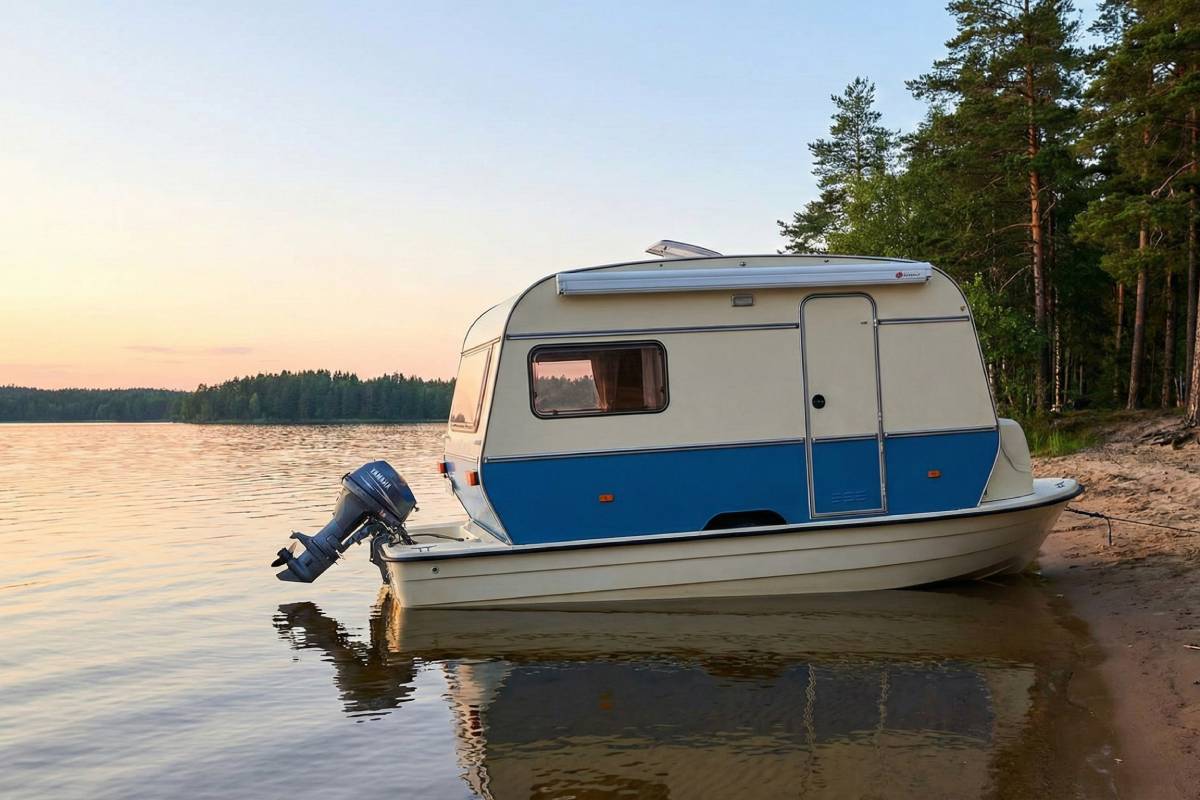
Enter the caravan boat (also called amphibious caravan, trailerable houseboat, or caravanboat hybrid), the ultimate solution for explorers who refuse to compromise.
TL;DR: About A Caravan Boat
A caravan boat is a hybrid vehicle that functions as a towable caravan (RV/travel trailer) on land and a motorized houseboat on water. It features a watertight hull, wheels for road towing, shallow draft for easy launching, living quarters (kitchen, beds, toilet), and an outboard motor for propulsion. Modern examples like CaraBoat, Departure One, and historical Caraboat allow seamless land-to-water transitions without needing separate vehicles.
What Exactly Is a Caravan Boat?
A caravan boat is a dual-purpose amphibious camper, part travel trailer, part small houseboat.
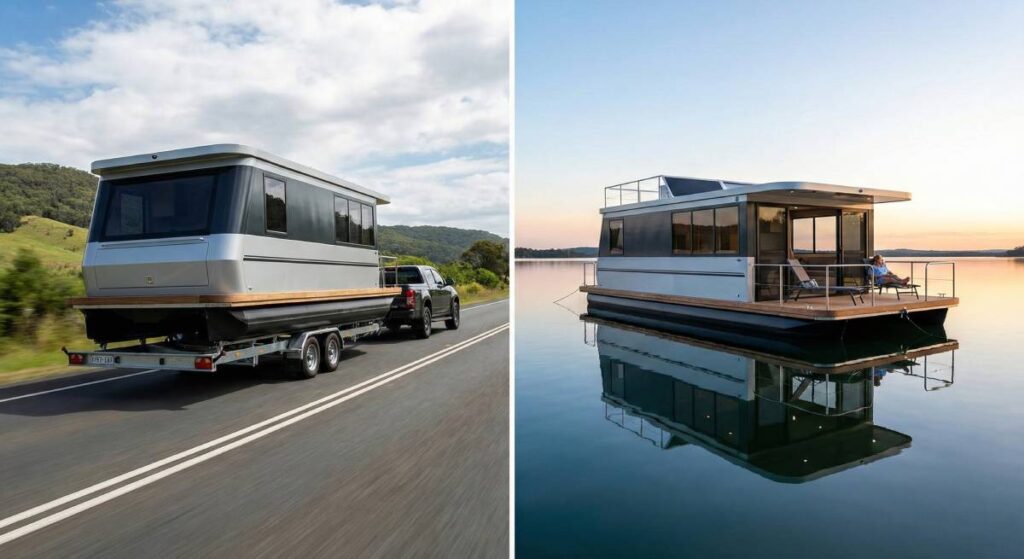
On land, it hitches to your SUV or truck like any caravan, with standard towing setup, suspension, and road-legal dimensions. On water, the hull becomes buoyant, wheels lift or stay submerged minimally, and an outboard motor (or electric drive in newer models) propels it like a shallow-draft cabin cruiser.
Unlike true amphibious cars (e.g., Gibbs Aquada), caravan boats prioritize living comfort over high-speed road or water performance. They excel in calm inland waters, rivers, estuaries, and protected coastal areas.
A Brief History of Caravan Boats
The concept dates back to the 1950s–1970s when inventors sought ultimate freedom.
- 1960s Origin: British firm Creighton Caravans launched the Creighton Gull (later renamed Caraboat), marketed as “the house that can float.” A 1968 British Pathé film showed one launching into the Thames after towing.
- 1970s Peak: The Caraboat used GRP (fiberglass) hull, steel backbone chassis, independent suspension, and initially waterjet propulsion (later outboard conversions). Only about 63 units were built; today they’re rare collector items.
- Modern Revival (2010s–2020s): Brands like CaraBoat (Australia/USA), Departure One (Germany), and others refined the idea with aluminum hulls, better insulation, electric/hybrid options, and luxury interiors.
The dream never died; it evolved.
How Does a Caravan Boat Work? (Step-by-Step)
Launching and using one is surprisingly straightforward:
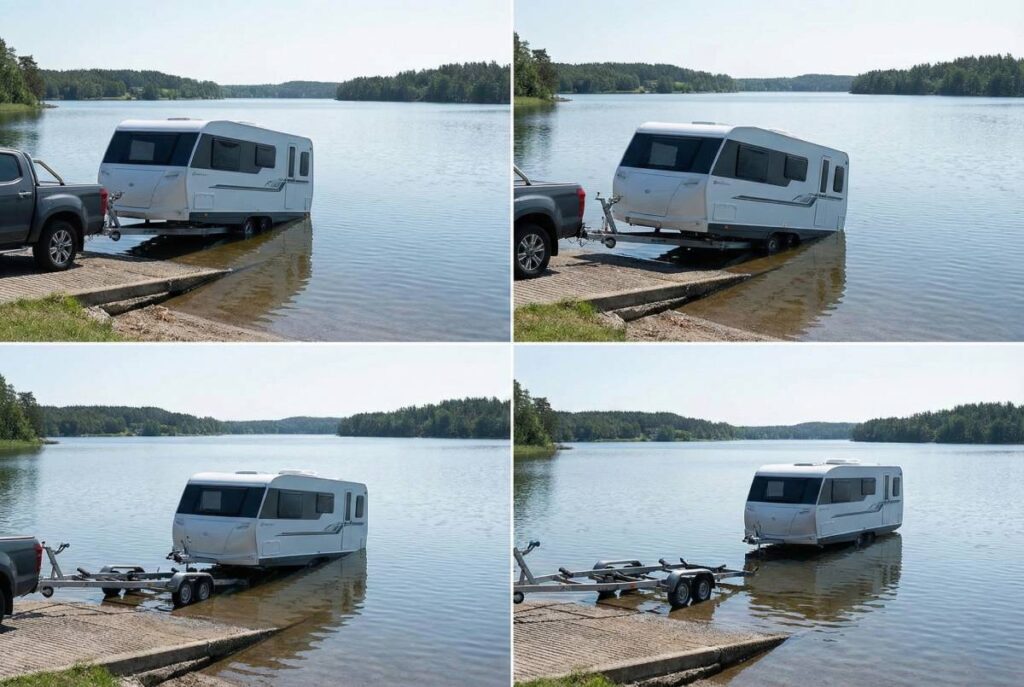
- Tow to Launch Site: Hitch and drive like a standard caravan (aerodynamic design keeps towing stable).
- Prepare for Water: Attach outboard motor (if removable), add fenders/bumpers, check bilge pumps and seals.
- Launch: Back down a boat ramp (shallow draft ~30–50 cm helps). Some models need minimal submersion of wheels.
- Transition: Once afloat, secure trailer (or leave attached in some designs), start motor, and cruise.
- Live Aboard: Anchor or moor; use kitchen, beds, toilet/shower, solar/heating for off-grid stays.
Recovery reverses the process, drive out or winch back onto trailer.
Key Features of Modern Caravan Boats
Today’s models focus on comfort, self-sufficiency, and durability:
- Hull & Construction: Aluminum or advanced GRP for strength, low maintenance, and corrosion resistance.
- Living Space: 2–4 berths, full kitchen (stove, fridge, sink), wet bath (shower + toilet), panoramic windows.
- Power & Systems: Outboard 15–50 hp (electric options growing), solar panels, water tanks, waste treatment, heating/AC.
- Towing & Mobility: Independent suspension, off-road capable trailers, height similar to standard caravans (~2.5–3 m). For towing, many owners debate Petrol vs Diesel engine cars in their tow vehicle. Diesel typically wins for superior torque, better fuel efficiency under load, and long-haul stability when pulling heavier caravan boats over distance.
- Water Performance: Shallow draft, stable in calm waters, speeds 8–15 knots.
Popular Caravan Boat Models Compared
| Model | Origin | Length | Berths | Hull Material | Key Highlights | Approx. Price Range (2025–2026) |
| CaraBoat 750/870 | Australia/USA | 7.5–8.7 m | 4 | Advanced composite | Panoramic views, twin engines option, luxury interior, easy launch | $150,000–$300,000+ USD |
| Departure One | Germany | ~8–9 m | 4 | Aluminum | Fully self-sufficient, off-road trailer, covered terrace, high-quality build | €200,000–€350,000 (~$220k–$380k USD) |
| Original Caraboat (vintage) | UK | ~5.5 m | 2–4 | GRP | Collector’s item, restored examples rare | $10,000–$50,000 (if found) |
| Sealander (lighter variant) | Germany | ~5–6 m | 2–4 | Fiberglass | Lightweight (~500 kg), towable by small cars, basic amenities | €30,000–€80,000 |
Pros and Cons of Owning a Caravan Boat
Pros
- Ultimate versatility — One vehicle for road trips and water adventures.
- Access remote spots — Anchor in secluded bays unreachable by car or standard boat.
- Cost savings long-term — No separate boat slip + caravan storage fees. Services like WA Freight (a Western Australia specialist) make interstate or regional relocation of your caravan boat straightforward and secure, especially useful in Australia, where many models originate.
- Off-grid capable — Solar, water makers, efficient systems for extended stays.
- Adventure factor — Feels like tiny-house living with endless horizon changes.
Cons
- Higher upfront cost than standard caravan or small boat.
- Limited to calm waters — Not suited for open ocean or rough conditions.
- Towing/launching skill required, plus factoring in tow vehicle choice like Petrol vs Diesel engine cars for optimal performance under load.
- Maintenance — Dual systems (road + marine) mean more checks.
- Legal/insurance — Varies by country (road registration + boat certification).
How Much Does a Caravan Boat Cost?
- Entry-level/lighter models: $50,000–$120,000 USD.
- Premium modern builds (CaraBoat, Departure One): $150,000–$400,000+ USD depending on size, options (electric drive, solar, luxury fit-out).
- Vintage restored Caraboat: $10,000–$60,000 if you find one.
Add trailer (often included), motor, insurance, and maintenance.
Is a Caravan Boat Right for You?
If you crave freedom without boundaries — road one day, river the next — and you’re ready for the unique lifestyle, yes. It’s perfect for retirees, digital nomads, couples, or small families who value experiences over possessions.
What about you? Would you trade two vehicles for one that opens both land and water worlds?